How to Layer Necklaces: Chain Lengths, Spacing and What to Buy First
Layering necklaces is less about how many you own and more about where they sit. Get the heights right and three necklaces look like one considered piece; get them wrong and even two look cluttered.
The three-length rule
Almost every layered look that works is built from three heights: one close to the throat, one at the collarbone, and one that hangs lower. You do not need three necklaces to start — two heights is already a layer.
- Close to the throat: 14 to 16 inches. This is where a small pendant or a plain chain sits.
- Collarbone: 18 to 20 inches. The most flattering height for a single pendant, and the one most people wear by default.
- Statement length: 24 to 30 inches. This layer hangs below the neckline and carries the visual weight.
Chain lengths vary by design, so check the product page for the actual measurement before you plan a stack. If a piece you already own has an extender, use it to fine-tune the height rather than buying something new.
Why two inches of spacing matters
Two inches is roughly the distance at which two chains stop competing. Closer than that and the chains tangle, the pendants overlap, and the eye cannot separate one layer from another. Further apart is fine — the layers simply read as two separate necklaces, which is a different look, not a worse one.
A good test: put the stack on, stand in front of a mirror, and look at it from two metres away. If you can count the layers instantly, they are spaced far enough apart.
Choose one anchor piece
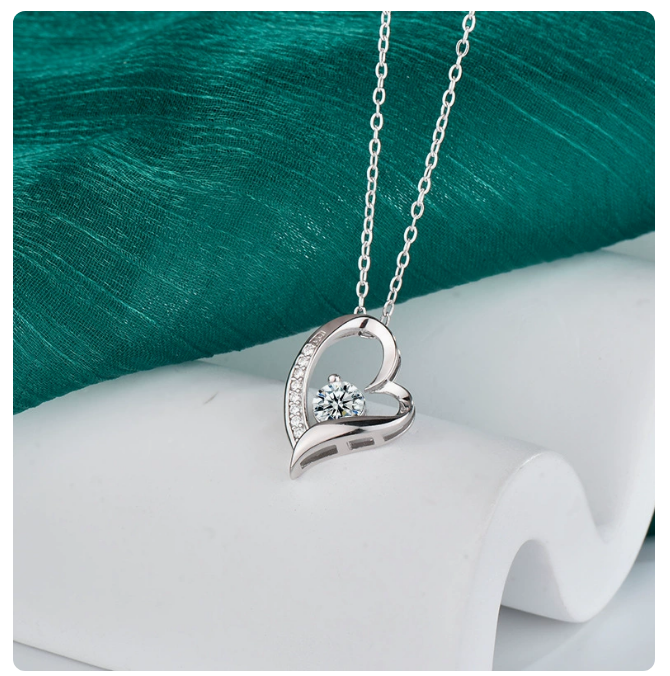
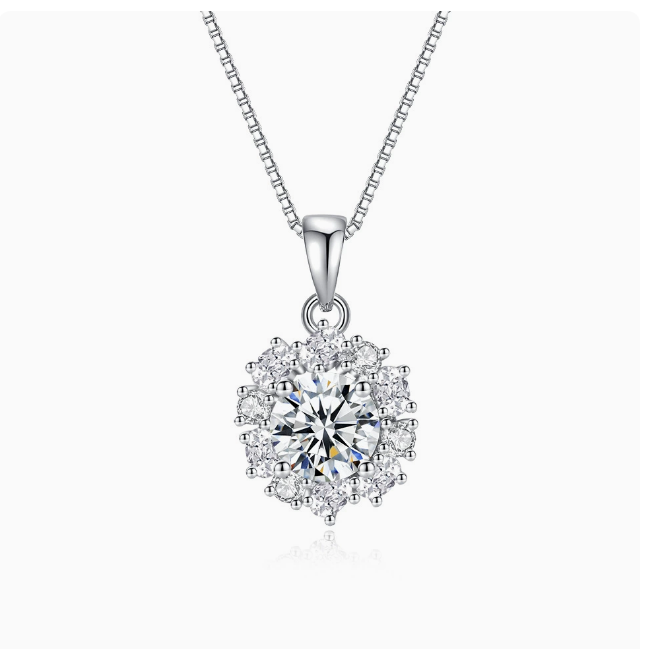
Every stack needs one piece that carries the look. For most people that is the necklace worn daily — often a single-stone pendant in recycled 925 sterling silver, small enough to sit under a shirt collar and bright enough to hold its own without a second layer.
Start there. A one carat moissanite pendant is a sensible anchor: it reads clearly at collarbone height, it is light enough to forget you are wearing it, and it works with everything above and below it.
Keep the metal consistent
Mixing metals is a legitimate style choice, but it is harder to pull off than it looks, especially in photographs. If you are building your first stack, keep everything in the same metal. Our pieces are all recycled 925 sterling silver, which means a stack built from them stays visually consistent by default.
Stones are the other consistency point. Moissanite has a distinctive fire — more coloured sparkle than a white-only stone — and it looks best when the pieces in the stack share it rather than competing with something brighter or flatter.
What to buy first, in order
- The daily piece. One pendant you would wear even if layering never existed.
- The shorter layer. A plain chain or a small charm that sits 2 inches above the first.
- The longer layer. Added last, and only if the neckline of your clothes leaves room for it.
Buying in this order keeps every purchase wearable on its own. Buying the statement piece first usually produces a necklace that only works in one outfit.
Layering and silver care
Two chains resting against each other will eventually leave fine surface marks on the silver. That is normal, not a defect, and it polishes out. The bigger issue is tarnish: sterling silver darkens faster in humid air and in contact with perfume, so store layered pieces separately and give them a quick polish every few weeks.
If you want the routine, our five-minute silver care ritual covers it. If you are also layering rings, the same logic of spacing and one focal point applies — see styling rings with clothing.
The short version
Pick three heights, leave two inches between them, let one piece lead, keep the metal the same, and buy the everyday necklace before the statement one. Everything else is personal taste.
Questions we get about this
What length should the shortest necklace in a layered stack be?+
Can you layer a pendant with a choker?+
Will layered necklaces scratch each other?+
Wear it, then decide.
Every piece ships with 30-day returns and one free ring size exchange. If it does not feel right, send it back — no explanation needed.
Explore the collection